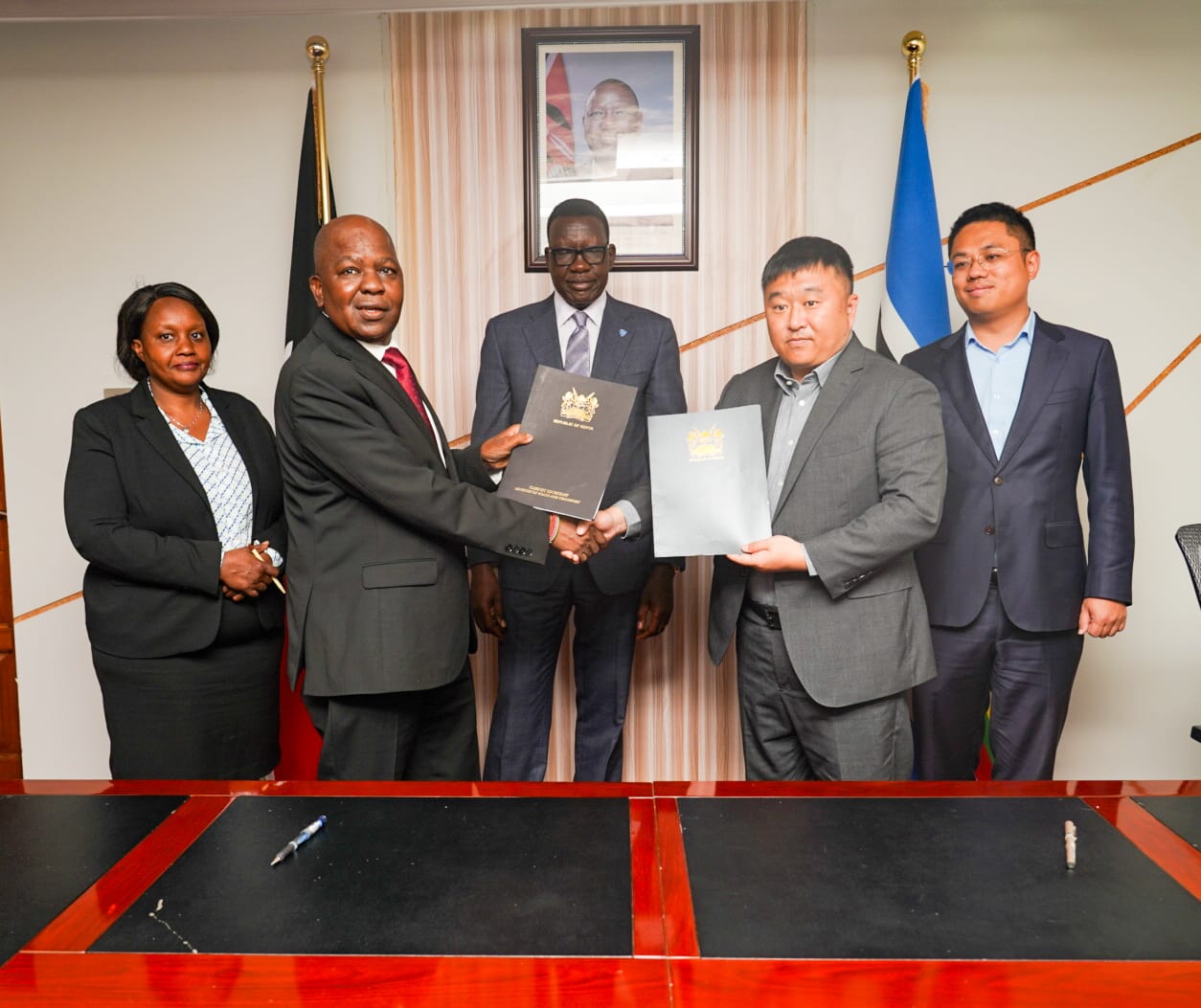
Cabinet Secretary for Roads and Transport Davis Chirchir on Tuesday witnessed the signing of an addendum to the commercial contract for the construction of the Naivasha–Kisumu Standard Gauge Railway (SGR) Phase 2B.
The addendum was signed by Kenya Railways Managing Director Philip Mainga and Yu Xiao Dong, representing China Communications Construction Company (CCCC), the contractor for the project.
The agreement formalises changes to the original contract to align it with the government’s revised financing strategy.
According to the Ministry of Roads and Transport, the addendum gives effect to a Cabinet decision approving the use of alternative funding mechanisms to finance the project, specifically through the securitisation of a portion of the Railway Development Fund.
CS Chirchir said the new approach reflects the government’s determination to deliver critical transport infrastructure while maintaining fiscal discipline.
“This model underscores the Government’s commitment to implementing strategic transport projects in a manner that is fiscally responsible,” he said.
He noted that the alternative financing arrangement is designed to support better sequencing of works and faster implementation, while enhancing transparency and oversight throughout the project lifecycle.
“It also strengthens risk-sharing arrangements between the public sector and our private partners,” Chirchir added.
Kenya Railways Managing Director Philip Mainga said the signing of the addendum clears the way for structured progress on the project under the revised funding framework.
He said the model would allow the corporation to manage implementation more effectively while safeguarding public resources.
The Naivasha–Kisumu SGR Phase 2B is a critical link in the expansion of the standard gauge network beyond Naivasha, extending rail connectivity to western Kenya and the Lake Region.
Once completed, the line is expected to significantly enhance regional connectivity and reduce transportation and logistics costs along the Western Corridor.
Officials say the railway will play a key role in boosting trade, supporting industrial development, and deepening economic integration within Kenya and across the wider East African region.
The project is also expected to ease pressure on road infrastructure by shifting cargo from road to rail, improving safety and reducing maintenance costs on major highways.
The signing of the addendum signals renewed momentum for the SGR Phase 2B, as the government seeks to balance infrastructure development with sustainable financing models amid constrained public finances.































Comments
Sign in with Google to comment, reply, and like comments.
Continue with Google